RaceForge.
Scan it · Drive it · Win it
Buying car parts is a blind bet.
Owners & tuners buy blind
You can't feel how a new spoiler, wheel set or brake kit changes your car until after you've paid and fitted it. That leaves buyers with uncertainty, while returns are slow and costly.
Sim-racers can't drive their own car
Many want their real car in Assetto Corsa. Today that requires bespoke manual 3D modelling, physics setup and integration — a specialist workflow out of reach for almost everyone.
Two audiences, one missing bridge: the real car, the simulator, and the parts market have never been connected.
We built this for our own race car first.
The problem on car #326
Before every setup change on our Formula Student car — a stiffer spring rate, a different push-pull rod ratio, a new anti-roll bar — we had to buy or machine the part first and only find out on track if it worked. Budget and build time we didn't have to spend on guesses.
What we validated
We scanned car #326, brought it into Assetto Corsa, and used our AI pipeline to create and compare multiple aero packages and suspension geometries. We evaluated each setup on track for driving feel and handling behaviour — not just raw numerical outputs.
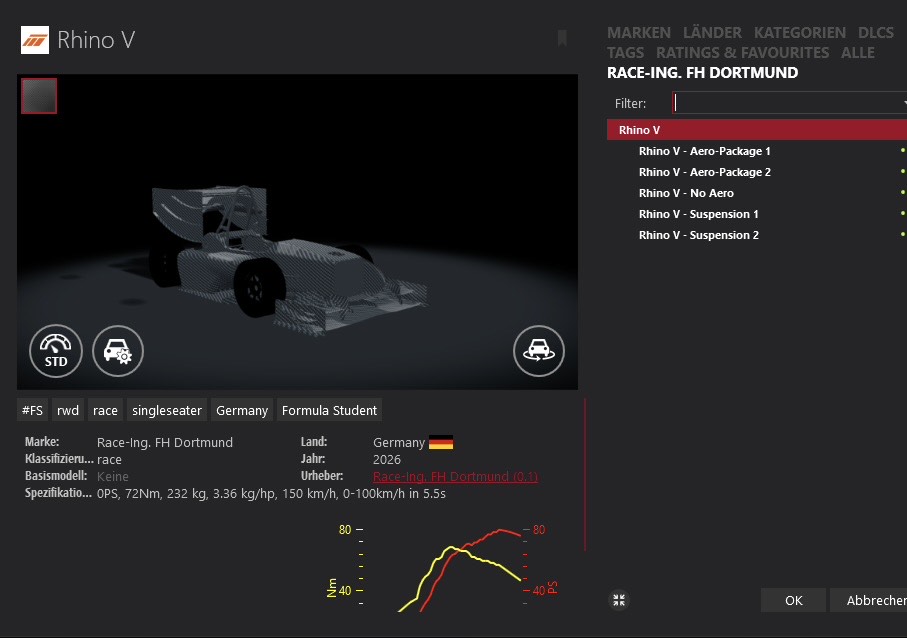
That's the market gap we found: the same AI pipeline lets drivers compare how parts change the car they feel, not merely the numbers they see. We generalised it — any car, any part, the same test-before-you-buy pipeline — and that pipeline is RaceForge.
One scan. Your real car in
Assetto Corsa.
RaceForge turns a phone LiDAR scan into a driveable AC car with real physics, then lets you test aftermarket parts in-sim before you buy.
The only product that connects real car → AI → Assetto Corsa → aftermarket parts, and turns it into a game you win.
Scan → AI → Race → Win.
- 01 · Scan: walk around your car; the phone's LiDAR + camera capture it in 360°.
- 02 · AI processing: the point cloud becomes a clean 3D mesh with correct weight, aero & collision physics.
- 03 · In Assetto Corsa: your car loads as a new, driveable vehicle (.kn5 + physics INIs, plug & play).
- 04 · Test parts: add spoilers, wheels, brakes as virtual mods and feel the difference on track.
- 05 · Tournament: race the community; winners take home the real part.
Feel the difference before you buy.
Any car
AI recognises brand, model & year and imports base parameters automatically.
Real physics
Part specs are converted to AC physics: weight, downforce, grip and braking all change.
Plug & play
Export .kn5, data.ini, engine.ini. Drops straight into Assetto Corsa, no modding skills.
Compare laps
Back-to-back with and without a part, so you see the lap time and feel the handling.
From point cloud to a car you can race. The whole pipeline runs on a phone scan and our AI stack. Test → decide → buy the part that actually works for you.
The timing has never worked before.
Hardware solved, market growing, AI affordable, regulation on our side. The window is open now.
A €118 Bn EU parts market, entered where we win first.
- EU aftermarket: €118B spare-parts market in 2023.
- German entry point: 49.5M passenger cars registered at the start of 2026.
- LiDAR market estimate: $3.27B (2025) → $12.79B by 2030, 31.3% CAGR.
- Racing-simulator estimate: 14.9% European CAGR through 2030; SimRacing Expo welcomed 24,370 visitors in 2025.
- Bottom-up SOM: 12,500 scans + 28,000 subscribers Y5 = €876K revenue.
No one bridges real car → AI → Assetto Corsa.
The only product combining all five:
- LiDAR scan of your own car
- AI-generated driveable AC model
- Aftermarket parts with real physics
- Community tournaments & prizes
- Minutes, not bespoke manual modding, at €12.99
Why it holds: real physics beats a cosmetic overlay, the AC player base already exists so there's no platform to bootstrap, tournaments turn parts demand into a flywheel, and the scan-to-physics pipeline is a dataset moat that compounds with every scan — on top of first-mover position in DACH and tournament community lock-in.
Three revenue streams, most of it recurring.
Pay-per-Scan
One-time. Turn your real car into an AC mod. The entry point.
Monthly Subscription
Unlimited part testing + tuning updates. The engine of the business.
Tournaments
Entry / Sport / Pro tiers. 60% of fees paid out as real parts. From Year 3.
Early signals.
B2B pipeline
kfzteile24 (€180M rev) & ATP (€66M) sell parts but offer no visualization, so they make natural "test-then-buy" distribution partners.
Regulatory watch
EU Digital Product Passports are being introduced progressively by product group. We monitor them as a future product-data opportunity.
Validation focus: benchmark the first vehicle-part workflows, measure simulation quality and validate willingness to pay with early users.
Community first, then the parts industry.
- GermanSimRacing Discord, the largest DACH sim server
- SimRacing Expo (13,600+ visitors) & Tuning World Bodensee
- Tuner influencers (JP Performance, 1.2M followers)
- Parts retailers embed "test in RaceForge" pre-purchase
- Affiliate revenue on parts users test then buy
- EU-DPP data pipeline as a moat & partner hook
Low-cost acquisition where our users already are. Then we monetise the €22 Bn aftermarket they buy from.
Break-even in Year 2, €301K profit by Year 5.
Revenue 0 → €95.6K → €257K → €473K → €876K. Net result −€278.9K → +€23K → +€89K → +€176K → +€301K. Source: JA_tool.xls.
€260,000 for 30%.
Use of funds
| AI MVP | €150,000 |
| App development | €55,000 |
| Website & platform | €55,000 |
| Total | €260,000 |
Founders keep 70%. No debt, no interest.
5× revenue exit multiple on €876K Y5 revenue → €4.38M company valuation, 30% stake = €1.31M. 38.3% IRR over the 5-year hold.
Built by racers who ship.
Miriam Zawierucha
Co-founder
Nikita Buls
Co-founder
Team plan
- 2 founders full-time from day one (€0 salary Y1)
- AI/R&D engineers: 0 → 1 (Y3) → 2 (Y4) → 3 (Y5)
- Formula Student pedigree: Team race-ing, car #326, FH Dortmund
The founding team combines hands-on Formula Student development, vehicle setup and product-building experience.
Scan it · Drive it · Win it.
DACH market leader by 2030 → European expansion.
Questions?
We've prepared backup on finance, market, competition, customer, product & company.
Open backup index → or press B
Backup: pick a topic.
Profit & loss, 2026-2030
| € | Y1 | Y2 | Y3 | Y4 | Y5 |
|---|---|---|---|---|---|
| Revenue (net) | 0 | 95,592 | 257,038 | 472,700 | 876,036 |
| − Material (COGS) | 0 | 11,289 | 31,833 | 57,722 | 106,663 |
| = Gross profit | 0 | 84,303 | 225,205 | 414,978 | 769,373 |
| − Personnel (incl. 25% SCC) | 0 | 37,500 | 99,375 | 189,000 | 270,000 |
| − Other operating | 18,900 | 23,720 | 36,380 | 45,000 | 58,880 |
| − Product investment (Y1)* | 260,000 | 0 | 0 | 0 | 0 |
| − Income tax | 0 | 0 | 0 | 4,613 | 139,086 |
| = Net result | −278,900 | +23,083 | +89,450 | +176,365 | +301,407 |
*App €55K + Website €55K + AI MVP €150K, expensed in Year 1, the product-build year, funded by the raise. Source: JA_tool.xls (5-GuV).
Cash, equity & the investment year
Cash & liquidity: positive from day one
| € | Y1 | Y2 | Y3 | Y4 | Y5 |
|---|---|---|---|---|---|
| Cumulative liquidity | 1,100 | 14,219 | 87,663 | 250,359 | 517,600 |
| Debt | 0 | 0 | 0 | 0 | 0 |
The raise keeps cash positive every year, so no bridge round is needed.
Equity: the Year-1 investment dip
| Share capital | €1,000 |
| Capital reserve | €275,100 |
| Contributed equity | €276,100 |
Year 1 expenses the full €260K product build, so equity briefly dips to −€2.8K at year-end, then turns positive again in Year 2 and compounds with retained profit. Zero debt throughout. This is a planned investment year, not distress.
Unit economics
| Product | Gross price | Net | COGS | Contribution |
|---|---|---|---|---|
| Pay-per-Scan | €12.99 | €10.92 | €1.50 | €9.42 · 86% |
| Monthly Subscription | €14.99 | €12.60 | €1.20 | €11.40 · 90% |
| Tournament (S/M/L) | €4.99 to €19.99 | €4.19 to €16.80 | 60% payout | €1.68 to €6.72 · 40% |
Software margins: the marginal cost of a scan or a subscriber-month is a few cents of compute plus store fees. Tournaments pay out 60% of entry fees as real parts, a marketing cost that drives retention.
Use of funds & cap table
Use of €260,000
| AI MVP (scan→physics pipeline) | €150,000 |
| App development | €55,000 |
| Website & platform | €55,000 |
| Total | €260,000 |
Spent in Year 1 to build the product.
Cap table (post-raise)
| Founders | 70% |
| Investor (€260K) | 30% |
| Debt | €0 |
Contributed equity €276,100 (share capital €1,000 + reserve €275,100). Return: 405% ROI / €1.31M investor value Y5 at a 5× revenue exit multiple (38.3% IRR).
Revenue by stream
| € (net) | Y1 | Y2 | Y3 | Y4 | Y5 |
|---|---|---|---|---|---|
| Pay-per-Scan | 0 | 42,588 | 91,728 | 149,604 | 245,700 |
| Monthly Subscription | 0 | 53,004 | 156,792 | 305,388 | 604,800 |
| Tournaments (from Y3) | 0 | 0 | 8,518 | 17,708 | 25,536 |
| Total revenue | 0 | 95,592 | 257,038 | 472,700 | 876,036 |
Y5 revenue mix
- 69% Monthly Subscription: €604,800
- 28% Pay-per-Scan: €245,700
- 3% Tournaments: €25,536
Subscription overtakes scans from Y3 Q3 and drives the recurring base. Tournaments launch Year 3. Annual stream values from JA_tool.xls (1-Um); totals from 5-GuV.
AI & operating costs, itemised
One-time build (Year 1, capitalised)
| AI MVP: scan→physics pipeline | €150,000 |
| App development | €55,000 |
| Website & platform | €55,000 |
| Total dev investment | €260,000 |
3-year useful life (see Investment slide).
Ongoing AI / processing cost
| Per scan (LiDAR → model) | €1.50 |
| Per subscription-month (part-test compute) | €1.20 |
| Tournament payout (of entry fee) | 60% → parts |
| € per year | Y1 | Y2 | Y3 | Y4 | Y5 |
|---|---|---|---|---|---|
| Processing cost (COGS) | 0 | 11,289 | 31,833 | 57,722 | 106,663 |
| Server, hosting, tools & admin | 18,900 | 23,720 | 36,380 | 45,000 | 58,880 |
AI inference cost per unit is held flat in the plan while volume scales, so gross margin rises to 88%. This is an internal planning assumption, not a market forecast. Source: JA_tool.xls (2-Mat, 5-GuV).
Investment & depreciation
| Asset | Amount | Life | Dep./yr* | Purpose |
|---|---|---|---|---|
| AI MVP | €150,000 | 3 yr | €50,000 | Scan→physics pipeline, vehicle recognition, AC export |
| App development | €55,000 | 3 yr | €18,333 | iOS/Android scan app + garage UI |
| Website & platform | €55,000 | 3 yr | €18,333 | Accounts, tournaments, payments, community |
| Total | €260,000 | 3 yr | €86,667 | = the raise |
*Straight-line depreciation over 3 years. Note: the current model books the full €260K in Year 1 (conservative: it front-loads the loss); the €86,667/yr straight-line view is shown here for reference. Either way the cash outflow is one-time in Year 1. Source: JA_tool.xls (3-Inv).
Valuation & exit
| Y2 | Y3 | Y4 | Y5 | |
|---|---|---|---|---|
| Revenue | 95,592 | 257,038 | 472,700 | 876,036 |
| Company value (5× rev) | 477,960 | 1,285,190 | 2,363,500 | 4,380,180 |
| Investor 30% stake | 143,388 | 385,557 | 709,050 | 1,314,054 |
5× revenue exit multiple, 38.3% IRR over the 5-year hold. The multiple is applied directly to Y5 net revenue — no discounted terminal-value stack.
TAM / SAM / SOM: how we size it
- TAM · €118 Bn: EU spare-parts aftermarket in 2023 (European Commission JRC). This is the broad market context, not our revenue forecast.
- SAM · sim-racer & tuner early adopters: a defined DACH beachhead within the 49.5M German passenger-car parc; customer validation will size the reachable segment.
- SOM · €876K Y5 revenue: bottom-up: 12,500 pay-per-scan users + 28,000 subscribers + tournament fees. A realistic, defensible capture, not a top-down %.
We deliberately lead with the bottom-up SOM (real users × real prices) rather than a "1% of a huge TAM" hand-wave.
Five tailwinds, 2026-2031
LiDAR
Third-party estimate of global LiDAR-market CAGR, 2025–2030; current iPhone Pro models include a LiDAR Scanner.
EU aftermarket
EU spare-parts market in 2023, according to the European Commission JRC.
Sim-racing
Third-party estimate of European racing-simulator CAGR through 2030; 24,370 visitors at SimRacing Expo 2025.
AI efficiency
Reported deployment-cost reduction for optimised AI inference; not used as an annual forecast.
German car parc
Passenger cars registered in Germany at the start of 2026.
EU DPP
Product passports are introduced progressively; no claim is made that they provide vehicle-physics data.
Why invest now
- 1 · Hardware is here: LiDAR is integrated into current smartphone models; the global LiDAR market is estimated to grow at 31.3% CAGR through 2030.
- 2 · The category is growing: third-party research estimates a 14.9% European racing-simulator CAGR through 2030; SimRacing Expo attracted 24,370 visitors in 2025.
- 3 · Our wedge is clear: manual AC modding requires specialist 3D, physics and integration work; we aim to make the workflow accessible at €12.99.
- 4 · Regulation is a watch item: EU DPP infrastructure will roll out progressively, but it does not currently guarantee part-physics data.
- 5 · The revenue compounds: 69% recurring subscription by Y5 makes the model predictable and scalable.
Feature matrix
| Capability | RaceForge | Manual AC mod | Polycam | 3DTuning | CARISTA | Forza/NFS |
|---|---|---|---|---|---|---|
| Scan your own car (LiDAR) | ✓ | manual | ✓ | ✗ | ✗ | ✗ |
| Your real car in Assetto Corsa | ✓ | ✓ | ✗ | ✗ | ✗ | ✗ |
| Aftermarket parts in sim | ✓ | partial | ✗ | visual | ✗ | cosmetic |
| Real physics simulation | ✓ | ✓ | ✗ | ✗ | ✗ | arcade |
| Tournaments & real prizes | ✓ | ✗ | ✗ | ✗ | ✗ | in-game |
| Minutes, not months | ✓ | ✗ | ✓ | ✓ | ✓ | ✓ |
Only RaceForge is ✓ across all six. The closest, manual AC modding, takes months and thousands of euros.
Competitor profiles & threat
Manual AC modding
Closest equivalent. It requires specialist 3D, physics and integration work. Threat: our wedge (accessible workflow, €12.99).
Polycam / Scaniverse
LiDAR scanning, 1M+ downloads, ~$700K/mo. Architecture/B2B focus, no AC export. Threat: medium (tech).
3DTuning
300+ models, visual configurator. No physics, LiDAR or AC. Threat: medium.
CARISTA
2M+ downloads, OBD2 diagnosis, €14.99/mo. Proves DACH pays for car apps. Threat: low.
Forza / NFS
15M+ players, fictional cars, cosmetic tuning, no aftermarket link. Threat: low.
kfzteile24 / ATP
Largest DACH parts dealers, no visualization → partners, not rivals.
SWOT analysis
Strengths
- Only bridge in the market: real car + AI + AC + real parts physics — no competitor combines all four (see Feature Matrix)
- Software-grade margins: 88% gross margin, 69% recurring revenue by Y5 — marginal cost per scan/subscriber-month is only €1.20–€1.50
- Low-CAC distribution: reaches users where they already are — sim-racing Discord, tuning expos, influencers — instead of paid acquisition
- First-mover in DACH: no direct competitor bridges LiDAR scanning, AC physics and real-parts tournaments today
Weaknesses
- Pre-revenue, small founding team
- Dependence on Assetto Corsa ecosystem
- Scan quality varies by user/phone
- Brand unknown at launch
Opportunities
- EU Digital Product Passport rollout (monitor by product group)
- B2B parts-retailer partnerships
- Sim-racing double-digit growth
- EU expansion after DACH
Threats
- Polycam / big scanner adds AC export
- AC licensing / modding terms change
- Slower-than-planned adoption
- AI-compute price spikes
Who buys, and why
The Sim-Racer
18-30. Plays AC / iRacing / BeamNG. Wants his real car in the sim, which until now meant months of manual modding.
The Tuner
22-38. Car meets, JP Performance, Tuning World. Buys on kfzteile24 and wants a more confident pre-purchase decision.
Gamer with a car
16-26. NFS / Forza / GT, just got a first car. Gen Z: +20% willingness to pay for digital car features.
Primary target 18-35 = 91% of the age distribution.
Reachable audience & willingness to pay
Where they gather (DACH)
- GermanSimRacing Discord, the largest DACH server
- SimRacing Expo: 13,600+ visitors, 84 exhibitors
- Tuning World Bodensee: 200+ exhibitors
- Essen Motor Show: 500+ exhibitors
Willingness to pay
- CARISTA: 2M+ users pay €14.99/mo, proof DACH pays for car apps
- One-off €10 to €20 accepted; subs need clear value
- Gen Z +20% WTP for digital car features (Deloitte 2026)
- 98% smartphone ownership, 18-29
What users actually say
The frustration today
- "I want my car in AC, not a generic look-alike mod."
- "Modding tools look like they're from 2010."
- "I buy a part and only then find out if it helps."
- "Months of 3D work just to drive one car, no thanks."
The evidence
- Uncertainty before buying parts is a recurring customer problem to validate in interviews
- CARISTA: 2M+ users pay €14.99/mo for a car app
- Gen Z: +20% willingness to pay for digital car features
- Returns on wrong parts are slow and costly
RaceForge removes the guesswork: test the part in your own car, in real physics, before you spend.
The AI stack
Point-cloud processing
LiDAR raw scan → cleaned, watertight 3D mesh.
Vehicle recognition
Auto-identifies brand/model/year, imports base parameters.
Physics calculation
Part data → AC physics params: weight, aero, grip, braking.
AC-mod export
.kn5 + data.ini + engine.ini, plug & play, no modding skills.
Built on affordable, fast-improving techniques (NeRF, Gaussian Splatting). The pipeline is the moat. Competitors would need years to replicate all four stages end to end.
Roadmap 2026-2030
| Year | Milestone | Revenue | Team |
|---|---|---|---|
| 2026 · Y1 | Build AI MVP + app + web; first beta users | €0 | 2 founders |
| 2027 · Y2 | Launch DACH; operational break-even | €96K | 2 |
| 2028 · Y3 | Tournaments launch; subs overtake scans | €257K | +1 R&D |
| 2029 · Y4 | EU-DPP data integration; scale | €473K | +2 R&D |
| 2030 · Y5 | DACH leader; ready for EU expansion | €876K | +3 R&D |
How the AI works
1 · Capture
Phone LiDAR + camera record the car in 360°: raw point cloud + images.
2 · Reconstruct
NeRF / Gaussian Splatting turn the cloud into a clean, watertight 3D mesh.
3 · Recognise
Model classifies brand / model / year and loads base physics parameters.
4 · Compute physics
Weight, aero, grip and braking derived; aftermarket parts recalculated on top.
5 · Export
Package .kn5 + data.ini + engine.ini, a plug & play Assetto Corsa car.
Raw scan in → driveable, physically correct car out. Each part swap re-runs step 4 only, so testing is instant.
The four-stage pipeline is the moat: a competitor must rebuild all of it, not just add LiDAR scanning.
Personnel plan
| € (incl. 25% SCC) | Y1 | Y2 | Y3 | Y4 | Y5 |
|---|---|---|---|---|---|
| Founders (headcount) | 2 | 2 | 2 | 2 | 2 |
| Founder salary / month | €0 | €1,250 | €1,563 | €2,300 | €3,000 |
| Founder cost | 0 | 37,500 | 46,875 | 69,000 | 90,000 |
| AI / R&D engineers (headcount) | 0 | 0 | 1 | 2 | 3 |
| R&D cost (€3,500 to €4,000/mo) | 0 | 0 | 52,500 | 120,000 | 180,000 |
| Total personnel | 0 | 37,500 | 99,375 | 189,000 | 270,000 |
Founders take zero salary in Year 1 and stay lean. Hiring starts only once revenue supports it. Personnel stays ≈31% of revenue at Y5. Source: JA_tool.xls (4-Per / 5-GuV).
Lean by design
Who does what
- Founder 1 · Product & Business: GTM, community, partnerships, finance
- Founder 2 · Tech & AI: scan pipeline, AC export, platform
- R&D engineers (from Y3): AI/physics, scaling, new sims
What we don't build in-house
- No hardware: the phone is the scanner
- Payments, hosting, store distribution: off-the-shelf
- Parts fulfilment for tournaments via retail partners
Headcount scales 2 → 5 across five years. Every hire is funded by revenue, not the raise.
Risks & mitigations
| Risk | Mitigation |
|---|---|
| Assetto Corsa modding / licensing terms | Engage Kunos early; architecture supports multiple sims (AC EVO, rFactor) |
| Scan quality varies by phone/user | Guided capture UX + AI cleanup + quality gate before export |
| Polycam/others add AC export | Moat = physics + parts + tournaments + community, not scanning alone |
| User acquisition cost | Community-led channels (Discord, expos, influencers) = low CAC |
| AI compute cost | Track unit cost per scan; use on-device processing where feasible and budget a cloud-cost ceiling |
Formula Student pedigree: Team race-ing, car #326, FH Dortmund. A team that has designed, built and raced under real constraints.
Market & community sources
European Commission / JRC →
VDA / KBA vehicle stock →
SimRacing Expo visitor information →
Apple technical specifications →
MarketsandMarkets LiDAR outlook →
KBV Research European outlook →
Technology & claim notes
AWS inference optimisation →
NeRF → · 3D Gaussian Splatting →
European Commission DPP overview →
Deliberately removed until primary evidence exists: 60% purchase doubt, 400M LiDAR phones, +22% DACH sim-racing growth, and a 2027 DPP requirement for part-physics data. Forecasts above are labelled as third-party estimates; financial projections remain internal planning assumptions (JA_tool.xls), not external market facts.
